
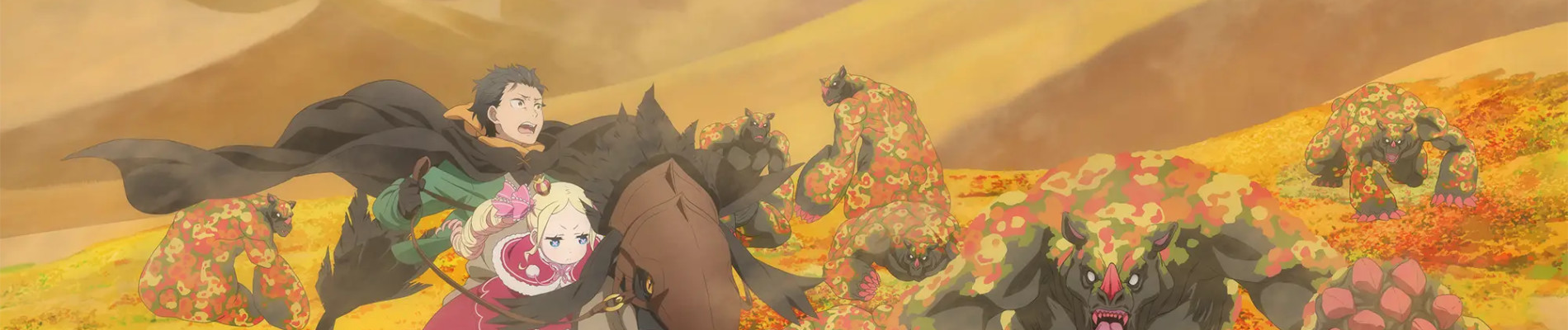
Re:ZERO Season 4 is doing the thing I wanted it to do and the thing I was slightly afraid it would do at the same time.
It is rewarding long-term viewers with real movement. Not fake movement, not another arc where Subaru spends eight episodes sprinting into the same emotional wall while the lore sits in the corner wearing sunglasses. Actual answers are starting to press against the glass. Old wounds matter. Character choices from earlier seasons are not being treated like decorative trauma. The show is behaving like it knows people have been waiting since 2016 for some of these threads to stop teasing and start biting.
It is also, very aggressively, not trying to win over anybody new.
That is probably the right call. As of June 13, 2026, AniList lists Re:ZERO -Starting Life in Another World- Season 4 as a 19-episode Spring 2026 TV season from WHITE FOX. It premiered April 8, 2026, and episode 11 is scheduled for June 17, with the back stretch beginning later in August. Crunchyroll announced the April 8 premiere slot for the series, and the weekly cadence has made Wednesday feel like the day Subaru clocks in for another shift at the emotional damage factory.
If you are behind, do not start here. I mean that lovingly. Go use the Re:ZERO watch order guide and come back when you have earned the right to suffer on schedule with the rest of us.
If you are caught up through Season 3, though? Season 4’s first half is exactly the kind of sequel I want from a story this deep into its own consequences: dense, patient, occasionally frustrating, but loaded with the sense that the machine is finally exposing gears it used to hide.
Quick verdict
The short version: Season 4 is strong, but it is not breezy.
WHITE FOX still understands the texture of Re:ZERO better than anyone else could. The direction is tense without turning every scene into melodrama. Masahiro Shinohara returns in the director’s chair, Masahiro Yokotani is credited on series composition, Haruka Sagawa remains central to the character design side, and Kenichiro Suehiro’s music still knows how to make a room feel haunted before anyone says the dangerous part out loud. Those names matter because Re:ZERO is a show where tone is everything. Get the tone slightly wrong and Subaru becomes unbearable, Emilia becomes too soft, Beatrice becomes a gag, and the witches become lore wallpaper. Season 4 mostly avoids those traps.
My first-half score right now would be an 8.5 out of 10, with the warning that this rating could swing depending on how the second cour handles payoff. Re:ZERO has always been a show that makes individual episodes feel stranger in hindsight. A scene that looks slow in week three can become the emotional hinge of week nine. That is part of the fun, and also why reviewing it mid-season feels like judging a puzzle while the show is still hiding half the pieces under the table.
What I can say cleanly is this: the first half justifies the wait if you were already invested. It does not justify jumping in cold, and it does not fully fix the franchise’s worst habit of explaining important ideas like it is afraid a viewer might blink. But when it hits, it hits with the old Re:ZERO nastiness. Not shock-value nastiness. The better kind. The kind where a character makes a decision, you understand why, and then the show makes you sit with how much that decision costs.
The best thing Season 4 does is trust the buildup
Re:ZERO has spent years training viewers to watch Subaru’s failures as information. Death is not just punishment here. It is data, trauma, strategy, and sometimes moral corruption wearing the same jacket. That has always been the hook, but by Season 4 the hook alone would not be enough. We have seen Subaru break. We have seen him bargain. We have seen him learn the wrong lesson, then the slightly better lesson, then the lesson that still hurts even when it is right.
Season 4 works because it does not pretend the old loop is new. Instead, it leans into the accumulated weight of everything Subaru has already survived.
That sounds obvious, but plenty of long-running anime fail this test. They keep resetting the protagonist emotionally because the original version was popular. Re:ZERO does the harder thing. Subaru is still Subaru. He is still impulsive, still loud, still capable of overpromising because his heart outruns his judgment. But the first half of Season 4 lets him feel shaped by the earlier seasons. His panic has memory now. His loyalty has scars. His confidence is not clean heroic confidence. It is closer to a guy walking into another burning building because he already knows what smoke tastes like.
That is why the quieter conversations in this season have landed better for me than some of the bigger set pieces. Re:ZERO has always sold itself with death loops and psychological horror, but its real strength is the gap between what Subaru can tell people and what he has to carry alone. Season 4 keeps pressing on that gap. The result is less immediately explosive than Season 1’s most famous breakdowns or Season 2’s Sanctuary cruelty, but it feels more mature. Subaru is not just reacting to pain. He is managing the ugly logistics of being someone who knows too much and can say too little.
As a busy adult watching weekly, I appreciate that more than I expected. I do not always have the energy at night for twelve layers of witch terminology and another emotionally loaded proper noun, but I do have energy for a character whose exhaustion makes sense. Season 4 understands that exhaustion.
Emilia and Beatrice are not just orbiting Subaru anymore
One of the easy complaints about Re:ZERO from the outside is that everything bends around Subaru. I get why people say that. The premise literally traps us in his perspective, and Return by Death makes his experience uniquely privileged and uniquely awful. But the best stretches of the series have always been the ones where the surrounding cast becomes more than a reaction surface for Subaru’s suffering.
Season 4’s first half is good at that.
Emilia, especially, feels more grounded here than she did in the earliest version of the story. She is still kind. She is still sometimes too earnest for a political world full of knives. But the show is better now at showing that kindness as a choice rather than a default personality setting. That matters. Early Emilia could feel like an ideal Subaru projected onto. Current Emilia feels more like someone carrying a history, a role, and a set of expectations she did not ask for but has to answer anyway.
Beatrice remains one of the franchise’s best emotional investments. The version of Beatrice we get after Season 2 is not just the library girl with a verbal tic. She is someone learning what it means to be chosen and then still having to live after the big catharsis. That is the kind of aftermath anime often skips. Re:ZERO does not. Season 4 keeps finding little ways to let Beatrice’s attachment to Subaru feel sweet, anxious, funny, and slightly sad all at once.
The show is also smarter than it used to be about group dynamics. The Emilia camp does not feel like a generic RPG party waiting for Subaru to select a dialogue option. People disagree. People withhold. People react from their own private histories. That makes the first half slower in places, yes, but it also gives the tension more surfaces to cling to. When Re:ZERO is at its best, a conversation at a table can feel as dangerous as a monster fight because everybody in the room is carrying a different version of the truth.
The pacing is still the tax you pay
Here is the part where I annoy the faithful: Re:ZERO still has a pacing problem sometimes.
Not always. Not even most of the time this season. But enough that it deserves saying.
Season 4’s first half has scenes where the dialogue is not just dense, it is double-parked. Characters restate emotional positions that were already clear. Lore arrives in blocks where I can practically feel the light novel paragraph structure underneath the adaptation. Re:ZERO is not alone in this, obviously. A lot of light novel adaptations struggle to turn internal architecture into television rhythm. But this show is too good for me to pretend I never feel the gears grinding.
The difference this season is that the friction usually has a purpose. I was more forgiving here than I was during some earlier stretches because the material feels like it is narrowing toward answers rather than widening into another maze. That is a huge distinction. A slow scene that deepens a character is patience. A slow scene that repeats a theme without adding pressure is padding. Season 4 has both, but thankfully more of the first.
The first half also benefits from having a clear weekly identity. It is not a binge rocket. Do not treat it like one. Watching three episodes in a row can make the exposition feel heavier than it is. Watching weekly gives the dread room to breathe, which is how Re:ZERO works best for me. It is a show built around anticipation, dread, memory, and the sick little moment when you realize a line from two weeks ago was not flavor text.
If you bounced off Re:ZERO because the dialogue felt too circular, Season 4 will not magically convert you. If you love the show but privately wish someone would occasionally cut a speech by twenty percent, congratulations, same table. We can be fans and still admit the franchise sometimes explains with both hands.
The production is controlled rather than flashy
Season 4 is not trying to be the loudest anime of Spring 2026. That is fine. Re:ZERO has never needed to win by out-spectacling battle shonen. It wins by making a hallway feel unsafe.
The first half looks stable, moody, and intentional. WHITE FOX keeps the faces readable, which matters in a show where tiny shifts in expression can carry more weight than a sword swing. The color choices lean into isolation and unease without making everything visually muddy. The backgrounds sell distance and vulnerability. And when the soundtrack comes in, it still has that Re:ZERO habit of making hope sound temporary.
Kenichiro Suehiro’s score is one of the franchise’s secret weapons. The music rarely begs you to feel something. It just lowers the temperature of the room until you notice your shoulders are tense. In Season 4, that restraint matters because the story is already heavy. A less controlled adaptation would underline every revelation three times and turn the whole thing into emotional soup. This first half mostly trusts silence, pauses, and the horrible little spaces between lines.
The action is effective when it arrives, but I would not call this a sakuga showcase first. That is not an insult. The show’s best visual choice is still how it frames Subaru when he realizes the shape of a problem. The camera understands helplessness. It understands the difference between a hero looking determined and a human being trying to convince himself he has one more attempt left in him.
That is Re:ZERO’s visual language, and Season 4 remembers it.
Spoiler-light: what this arc is really testing
Without getting into novel spoilers or spelling out every reveal, Season 4’s first half is testing whether Re:ZERO can shift from mystery accumulation to mystery payment without losing its identity.
That is hard. Mystery-box storytelling can survive for years on implication. The second you start answering, you risk making the world feel smaller. Re:ZERO has avoided that so far by making answers create emotional consequences instead of just wiki entries. A reveal matters because it changes what Subaru, Emilia, Beatrice, or the larger camp can bear. That is the correct instinct.
The first half is also testing Subaru’s role as a leader. Not a chosen-one leader in the clean fantasy sense. More like the guy who has died into enough information that he can sometimes see the outline of a disaster before everyone else does. That is useful, but it is also corrosive. He can look irrational because he is reacting to things only he remembers. He can look heroic because nobody else sees the failed attempts. He can look manipulative because sometimes the only way to save people is to move them like pieces without explaining the board.
That moral tension is where Re:ZERO still feels sharper than most isekai. A weaker show would treat Return by Death as a cheat code with trauma attached. Re:ZERO treats it as a spiritual burden. The power does not make Subaru special in a triumphant way. It isolates him, warps his choices, and creates a version of heroism that looks suspiciously close to self-destruction if you stare at it too long.
That is why I am still here. Not because the lore is big, though it is. Not because the cast is beloved, though it is. I am here because Re:ZERO keeps asking whether saving people still counts as salvation if the person doing it is being hollowed out in the process.
That question has teeth.
Is Season 4 better than Season 3 so far?
For me, yes. At least through the first half.
Season 3 had important setup and several strong moments, but it sometimes felt like a bridge season in the most literal sense. Necessary, occasionally impressive, but built to move us from one major emotional geography to another. Season 4 feels more like arrival. Not final arrival, obviously, since the source material is still much larger than this season, but arrival at a zone where the story’s long-running obsessions are being forced into the open.
That said, Season 3 may age better after Season 4 finishes. Re:ZERO seasons often improve backward. The thing you thought was slow setup becomes sharper once you see what it was setting up. That is why I am cautious about declaring too much while we are still mid-run.
Compared with Season 2, Season 4 is less immediately devastating so far. Season 2 had the Sanctuary arc’s claustrophobic emotional cruelty and some of the strongest Beatrice material in the entire anime. Season 4 has not surpassed that for me yet. But it is operating on a broader canvas. It feels less like one emotional prison and more like a convergence point for half the show’s mythology.
Compared with Season 1, it is not as clean an entry. Of course it is not. Season 1 had the advantage of discovery. It could shock you because you did not yet know how cruel the premise was willing to be. Season 4 has to shock people who already know the trick. The fact that it still finds ways to make me uneasy is a very good sign.
Who should watch it now, and who should wait?
Watch weekly if Re:ZERO is one of your shows. If you are the kind of viewer who likes reading reactions, arguing theories, and letting dread build between episodes, this is a strong weekly ride. The June 17 episode 11 slot also makes this a good time to catch up on the first ten episodes before the season shifts into its next stretch.
Wait and binge if exposition-heavy weeks frustrate you. Some viewers will have a better time when they can move straight from setup to payoff. I would not blame you. Re:ZERO can feel punishing when an episode ends on a question and your reward is seven days of sitting there like Subaru after another terrible realization.
Do not watch yet if you have not finished the earlier seasons. Seriously. This is not a show where you can skim a recap and vibe your way through. At minimum, you need Season 1, Memory Snow, The Frozen Bond, Season 2, and Season 3. The emotional math depends on it. If you need a broader seasonal map before deciding what to prioritize, the Spring 2026 anime watchlist is the better starting point.
And if you simply want lighter fantasy comfort right now, maybe do not pick the show where the main character’s superpower is technically a panic attack with save points. There is no shame in choosing peace. I say that as someone who keeps choosing this nonsense anyway.
Final verdict on the first half
Re:ZERO Season 4’s first half is dense, emotionally mean, and better than it has any right to be this deep into the franchise.
It is not perfect. The dialogue can over-explain. The pacing still occasionally stops to organize its lore binders. The barrier to entry is basically a locked steel door with Subaru crying behind it. But the season understands what longtime viewers came for: psychological pressure, character debt, mythological payoff, and that uniquely Re:ZERO feeling that hope is real but never free.
The thing I respect most is that Season 4 does not flatten Subaru into either a hero or a punching bag. He is both brave and damaged, funny and exhausting, necessary and not always right. That tension is the show. The first half remembers that, then builds outward instead of sanding him down into a cleaner protagonist.
So yes, the new arc justifies the wait. Not because every episode is flawless, and not because Re:ZERO has suddenly become easy television. It justifies the wait because the story still feels dangerous. Not random. Dangerous. Like the past is finally catching up, the mysteries are tired of being patient, and Subaru is once again the poor idiot standing exactly where the blade is going to fall.
I hate that for him.
I will absolutely be there next Wednesday.
Sources checked this run
- AniList entry for Re:ZERO -Starting Life in Another World- Season 4 (ID 189046): 19 episodes, Spring 2026, April 8, 2026 premiere, WHITE FOX, airing schedule, staff credits, and official art.
- AniList relations for Season 4: Season 3 listed as prequel, the original light novel listed as the adaptation source, and Break Time Season 4 listed as a spin-off.
- Crunchyroll News search result for the April 7, 2026 premiere announcement: April 8, 2026 release timing and Crunchyroll availability.
- Existing iCraveAnime coverage: Re:ZERO watch order guide and Spring 2026 anime watchlist.


