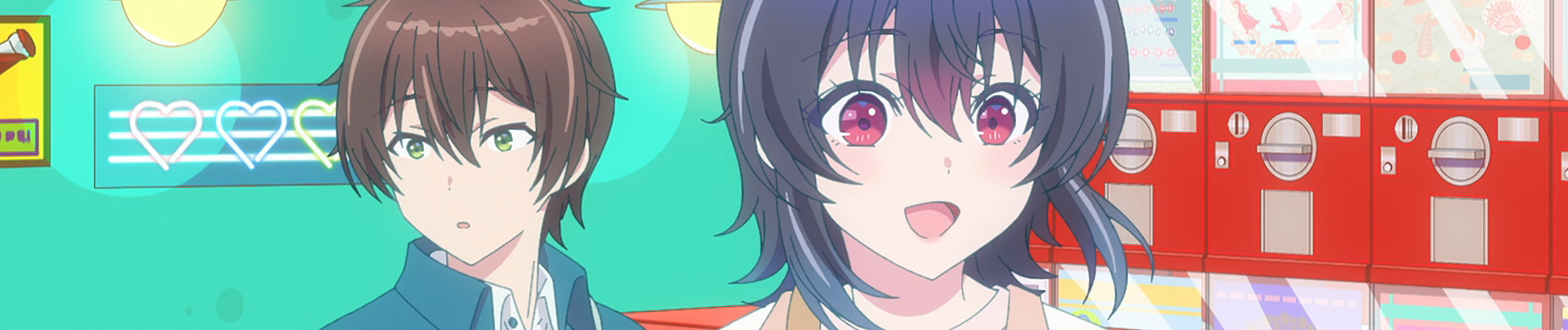
I Made Friends with the Second Prettiest Girl in My Class sounds like a romance built from a ranking made by bored teenage boys. The season’s friendship arc can be read as a push against that ranking, even though the marketing never leaves it behind.
The 12-episode record contains more than a lonely boy receiving attention from a beautiful girl who likes video games. Its central arcs concern private selves: the version of Umi Asanagi who exists away from school, the version of Maki Maehara who is not defined by an awkward introduction, and the version of Yuu Amami who is more than the person everybody calls number one.
The official summaries still use jealousy, possessiveness, beauty rankings, and convenient access to popular girls as romance mechanisms. The later arcs complicate the title’s ranking without removing those conventions.
Method note: This is a source-based season guide, not a firsthand viewing report. The analysis uses the complete official episode record, production data, and independent premiere criticism. It maps documented plot and credit information rather than judging full-season animation, acting, music, pacing, or direction. Plot details through episode 12 follow.
The quick answer
The official episode sequence documents substantial relationship movement inside one complete cour. Maki and Umi begin as secret Friday friends, become emotionally entangled, meet each other’s families, and finish the season after navigating school, parents, illness, holidays, and mutual friends.
The documented plot does not turn Yuu into a disposable romantic rival. The title invites a competition between two girls, while episodes 4 and 5 focus on how Umi can love Yuu, resent living in Yuu’s shadow, and still need a life that belongs to her.
The premise uses familiar wish-fulfillment ingredients. The official summaries also record jealousy-driven flirting and possessive reactions, which may be a poor fit for readers who dislike those romance conventions.
The AniList record lists a finished 12-episode Spring 2026 TV anime, with 24-minute episodes airing from April 7 through June 23. It showed an average score of 80 when checked on July 28. The plot record points toward viewers seeking relationship and family developments, not viewers looking for an unconventional premise.
The title’s ranking is the problem
The classroom label calls Yuu the prettiest girl and Umi the second prettiest. Maki does not invent it, and the later friendship material gives readers a strong reason to see the label as evidence of how little the class understands Umi. That interpretation helps. It does not make the phrase stop sounding gross.
Anime Feminist’s episode-one review made the sharpest objection: ranking teenage girls creates a hierarchy before either girl gets to define herself. The review also praised the more grounded idea underneath it. Teenagers often maintain different social circles at school and at home because each space permits a different version of them.
That is the show’s actual hook. Umi is not a consolation prize behind Yuu. She is tired of being interpreted through Yuu at all.
The official episode guide establishes that in episode 1 without a giant speech. Maki’s classroom self-introduction goes badly, but it reveals his real interests: B-movies, games, and manga. Umi remembers. She approaches him away from the classroom, gives him an honest introduction card, and starts a friendship where neither person has to perform for the class.
That detail adds a second function to the usual “popular girl secretly likes nerd stuff” setup. Umi pays attention to a moment Maki wants everyone to forget. Maki gives her a place where being funny, competitive, hungry, or obsessed with a B-movie has no effect on her social rank.
The title sells wish fulfillment. The first episode quietly builds mutual relief.
Friendship is the romance’s real infrastructure
A weaker version of this story would rush from shared hobbies to accidental touching and call the job done. Second Prettiest Girl instead spends its early arc testing whether the private friendship can survive other people.
Episode 2 creates the first pressure point. Maki exchanges contact information with Yuu, then runs into Yuu and Nina while he is out with Umi. He refuses Yuu’s invitation too sharply because he is trying to protect the secret. The problem is not that another pretty girl might steal him. It is that secrecy makes normal social contact feel like betrayal.
Episode 3 pushes Yuu inside Maki and Umi’s private space. Umi sees Maki and Yuu behaving comfortably in the same home where she usually gets him alone. The resulting tension can be read as territorial as well as romantic: the one place where Umi gets to be separate from her school identity is no longer separate.
The culture-festival arc gives that conflict a public test. In episode 4, Maki draws one of the class committee slots. Other students joke that the remaining slot is a bad draw because working with him would be unpleasant. Yuu gets angry. Umi claims the second slot and stops the room from turning Maki into a punchline, even though she did not actually draw it.
That is the point where Umi’s affection becomes useful instead of decorative. She does not merely tell Maki that he is secretly wonderful. She changes the social situation when everybody else is making him smaller.
Episode 5 then turns toward Umi. She explains that being known as “Yuu’s best friend” has cost her friendships and made her a target for exclusion. She loves Yuu, but other students treat that friendship as her entire identity. Maki’s instinct is to give Umi back to Yuu and step away. It sounds selfless. It is also wrong, because it assumes Umi cannot choose both relationships.
That is the season’s most adult idea: adding one meaningful relationship does not have to demote another. Friendship is not a ladder with one person at the top.
The site’s Spring 2026 sleeper test covered the opening stretch. The official summaries show that the later stakes remain social and domestic: secrecy, friendship, family separation, illness, and holiday milestones rather than action or supernatural conflict.
Umi and Yuu are more interesting than a love triangle
The obvious commercial move would be to make Yuu want Maki, force Umi to compete, and spend the season teasing which girl wins. The official episode sequence does not build that structure.
Yuu matters because she exposes Umi’s mixed feelings. The official guide records her defending Maki when classmates mock him, while episode 5 records Umi describing how being known as Yuu’s friend led to exclusion by other students. Neither girl needs to be malicious for that imbalance to exist.
Anime News Network’s Spring 2026 preview guide split hard on the premiere. Rebecca Silverman found the friendship pleasant but the setup bland. James Beckett dismissed it as familiar wish fulfillment. Richard Eisenbeis saw Umi’s attempt to build an identity outside Yuu as the real hook. ANN also discloses Kadokawa group ownership on that page, which is worth knowing when weighing the coverage.
The full official episode record gives the third angle substantial support. Umi’s stated problem is not simply that Yuu ranks above her. Episode 5 says she has been defined as Yuu’s friend and excluded because of that role. Maki meets Umi through shared taste and attention rather than classroom status.
The official episode 8 summary also says Umi becomes jealous while Maki helps Yuu study and flirts with him in front of their friends. Readers who see jealousy and possessiveness as weak romantic shorthand should count that as a warning.
Still, refusing to villainize Yuu matters. A romance about escaping shallow labels would sabotage itself if it turned the “prettiest girl” into a shallow obstacle.
The family arc is where Maki stops being a blank lead
Maki initially looks like another anxious romance protagonist built to receive attention. His shyness is broad, his social position is convenient, and Umi drives most of the early movement.
Episodes 7 through 10 finally give his withdrawal a history.
Episode 7 starts with Maki meeting his father, Itsuki, alongside a coworker named Kyoka Minato. The encounter pulls him back into memories of his parents’ damaged relationship. Even during a meal with Umi and Yuu, he remains distracted. His first date with Umi follows, and the two choose a romance movie because it feels date-appropriate even though both would rather watch a B-movie.
That event repeats a central pattern in the episode record. Performing the expected version of romance works less well for them than choosing the supposedly embarrassing thing they actually enjoy.
Episode 8 brings friends into Maki’s home for studying, then returns him to the question of his father and Kyoka. Episode 9 places him at Umi’s family dinner. The Asanagi household welcomes him so easily that he begins crying as he remembers when his own parents could share a warm table.
This is the point where the official plot shifts from classroom isolation to family rupture. Maki’s loneliness is no longer explained only by weak classroom confidence.
Episode 10 refuses an easy repair. Maki tries to bring his parents together at the Christmas party. They argue. His plan fails. What changes is not the marriage but Maki’s willingness to say what their separation did to him.
The official summary does not use Umi’s love to restore Maki’s family. The relationship accompanies his confrontation with the problem; it does not solve the adults for him.
For busy adults sorting seasonal shows, this family material distinguishes Second Prettiest Girl from a romance made only of school and holiday scenes. Our anime for adults guide covers series built more centrally around adult concerns; here, the documented family arc explains how teenage loneliness can begin at home even when nobody is cruel.
The relationship actually moves
A completed romance cour should not feel embarrassed by progress. This one is not.
The official guide moves Maki and Umi through private Friday visits, a culture festival, Christmas plans, a first date, family dinners, illness, New Year’s, Valentine’s Day, White Day, and Umi’s April 3 birthday. Those are conventional milestones. Their accumulation is the appeal.
Episode 11 has Umi and her family care for Maki while he is sick. Umi’s mother thanks him for being good to her daughter, and Maki promises to value the relationship. The moment is domestic rather than spectacular. He is no longer a secret guest who exists only on Fridays. He has entered a family system.
Episode 12 lets time pass. Umi struggles with Valentine’s chocolate, so she and Maki make it together. Maki returns the gesture on White Day. The season reaches Umi’s birthday and a new school year without blowing up the relationship to manufacture a finale.
The official guide does not record a last-minute breakup or misunderstanding. It closes on ordinary continuity, with Valentine’s Day, White Day, and Umi’s birthday marking time inside the relationship.
This is also why the show fits the same audience as our best short anime for busy adults, with one caveat: the cour is complete, but the larger source story continues. Twelve episodes give you a clean relationship stage, not the final word on every character.
Concerns the source record does not erase
The title is not the only problem.
First, the series leans on a fantasy where an isolated boy’s niche tastes are enough to make the popular girl seek him out. Umi has agency, and her need for private identity makes the choice believable, but Maki begins with very little active social courage. The story eventually develops him. The invitation still arrives at his door.
Second, the official summaries repeatedly connect Umi’s jealousy to possessive behavior. Her fear of losing a private refuge is established in episode 5, but readers who reject jealousy as romantic shorthand should not assume that pattern disappears.
Third, the premiere drew a specific presentation complaint that should not be brushed aside. Anime Feminist criticized occasional leering framing in episode 1, especially shots that move across the girls’ bodies. That source covers the premiere, not the full season, so it supports a warning about the opening episode rather than a season-wide visual verdict.
The production facts explain the consistency more than they promise spectacle. AniList credits CONNECT as the animation studio, Hideki Tachibana as director, Keiichiro Ochi on series composition, and Shoko Takimoto on character design. The sourced franchise record also identifies Takata’s light novels as the source and records the principal staff and 2026 television run.
The official episode credits document unusual staff continuity: Ochi is listed as scriptwriter across all 12 entries. Tachibana storyboarded or directed several key episodes, including the premiere and finale. The friendship-and-family thread also remains visible across the official summaries. Connecting those two facts is an editorial reading, not a documented production claim.
Who is this season guide pointing toward?
Watch it if:
- You want a finished 12-episode school romance with visible progress.
- Friendship drama interests you more than a competitive love triangle.
- You want a family subplot alongside the school relationship.
- You like romances built from shared hobbies and comfortable time at home.
- You prefer social and domestic stakes to action or supernatural conflict.
Skip it if:
- The beauty-ranking premise is a deal-breaker.
- Popular-girl-meets-lonely-boy wish fulfillment already exhausts you.
- Jealousy played as affection makes you impatient.
- You need an unusual premise rather than familiar school-romance plotting.
- You want a fully concluded source story rather than a season stopping point.
The Summer 2026 romance preview has newer options if seasonal conversation matters most. Second Prettiest Girl has the advantage of being done. No weekly gamble, no premiere hype, no wondering whether episode 10 will collapse the whole thing.
Final takeaway
My source-based reading is that I Made Friends with the Second Prettiest Girl in My Class becomes more interesting when its story pushes against the title’s logic. Umi is not valuable because she ranks second. Yuu is not an obstacle because she ranks first. Maki is not rescued because he secretly deserves the prettiest available girl.
The episode sequence is most coherent when all three are allowed to be more than the classroom’s first impression of them.
Its romance outline is conventional. Its friendship and family arcs give Maki and Umi motives beyond attraction. The official finale records forward movement without a last-minute breakup or disaster.
Takeaway: the documented 12-episode arc fits viewers seeking relationship progress, friendship conflict, and a substantial family subplot inside one finished cour. Skip it if the title’s ranking system or jealousy-driven romance conventions poison the premise for you, because the plot pushes against that hierarchy without escaping the marketing built from it.
FAQ
How many episodes are in Second Prettiest Girl?
The anime has 12 episodes at approximately 24 minutes each. AniList lists the series as finished.
When did the anime air?
It ran from April 7 through June 23, 2026 as part of the Spring 2026 season.
Is the first season complete?
Yes. The official guide lists all 12 episodes, and the finale reaches Umi’s birthday after moving through Valentine’s Day and White Day. The larger light-novel story continues, but the anime season ends at a clear relationship milestone.
Is it a love triangle?
Not in the usual competitive sense. Yuu affects Maki and Umi’s relationship, but her central role is as Umi’s closest friend and the person whose popularity has shaped Umi’s identity. The season does not build toward Maki choosing between them.
Is it only wish fulfillment?
The setup absolutely uses wish-fulfillment ingredients: a lonely boy, a popular girl, shared nerdy interests, and secret visits. The later friendship and family arcs give those ingredients more emotional structure than the premise initially promises.
Where can you stream it?
AniList links Crunchyroll for the series. Streaming catalogs vary by region, so confirm the title appears in your local service before subscribing.
Sources checked
Schedule, format, staff, score, and asset data were checked on July 28, 2026 against AniList. Episode events and credits were checked against the official 12-episode story guide. Critical context came from Anime News Network’s multi-critic premiere guide and Anime Feminist’s episode-one review. Source-publication and production history were cross-checked with the Wikimedia Foundation’s sourced franchise record.