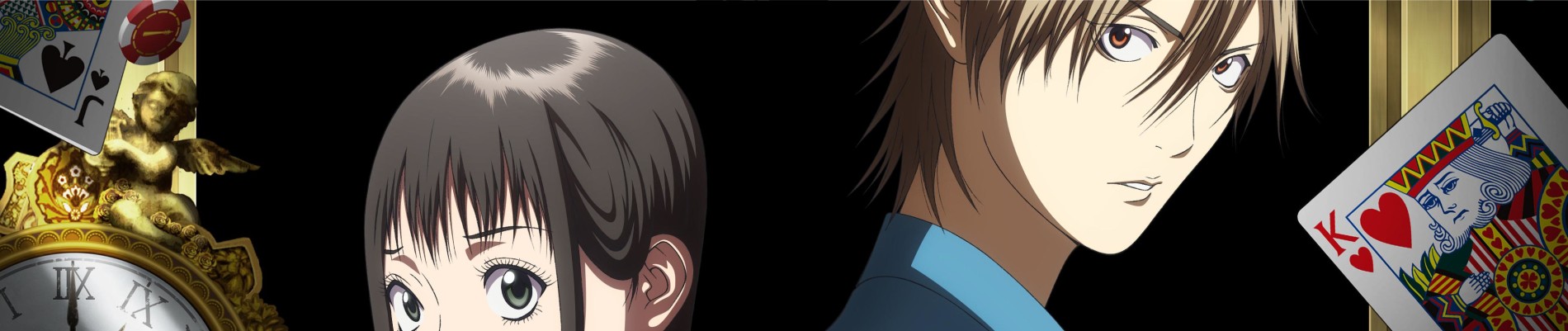
Liar Game has a wonderfully mean premise: give the most honest person in the room 100 million yen, tell her that everybody is allowed to steal it, then charge her the loss when somebody inevitably does.
The anime is now 17 episodes deep. It has already moved through a two-person theft, a 22-player voting trap, a nine-person elimination game, and a team contest built around smuggling imaginary cash. That sounds like four seasons of strategy packed into one. The official episode breakdown also shows why the adaptation uses several episodes to establish and resolve each contest.
This is not Death Note with a different notebook. Its documented structure resembles a strategy game that states its rules, exposes a loophole, explains the loophole, and then reveals that one player manipulated the group before the formal contest began. Viewers who enjoy explicit rules and reconstructable solutions are the clearest fit. Viewers who prefer strategy to remain implicit should treat that structure as a warning.
Method note: This is a source-based reality check, not a firsthand viewing review. It uses the official episode record through episode 17, current production and schedule data, and independent industry reporting. It can evaluate the documented game structure, character choices, adaptation scope, and audience fit. It does not claim firsthand judgment about animation, acting, music placement, or moment-to-moment direction. Spoilers through episode 10 follow; later arcs are discussed more broadly.
The quick verdict
The documented first 17 episodes build a patient psychological series whose central idea is not merely Akiyama’s genius. It is Nao turning honesty from a liability into a strategy.
The opening is deliberately narrow. Episodes 1 through 3 cover the 100 Million Yen Game. Episodes 4 through 7 expand the field with Minority Rule. Episodes 8 through 10 run the Downsizing Game. Episode 11 begins Contraband, which is still developing in the current official record.
That structure allocates separate episodes to rules, alliances, betrayal, recovery, and explanation. The anime therefore does not document a completely new game every week. A single reversal can require setup in one episode and proof in the next.
The AniList record listed the show as a releasing Spring 2026 TV anime from MADHOUSE, with 24-minute episodes and a 61 average score when checked on August 1. Seventeen episodes had aired, and episode 18 was scheduled for August 3 in US Eastern time. AniList had not filled in a final episode total, so any exact total being passed around should be treated cautiously.
Independent reporting gives the run a clearer shape. Anime News Network reported a continuous six-month broadcast, and its second-part announcement confirms that the story rolled forward without a seasonal break.
The series best fits viewers who enjoy explicit rules, coalition math, social manipulation, and solutions that can be reconstructed after the reveal. It is a weaker fit for viewers who want rapid escalation or minimal explanation.
The premise is cruel in a very practical way
Nao Kanzaki is known for being absurdly honest. The official series site describes the original manga as Shinobu Kaitani’s suspense story, serialized in Weekly Young Jump from 2005 to 2015. The anime does not ease Nao into danger. A package arrives with 100 million yen and an invitation she cannot refuse.
The first opponent is Kazuo Fujisawa, her former teacher. He reassures her, takes the money, and leaves her facing a 100-million-yen debt. Nao turns to Shinichi Akiyama, a con artist just released from prison after destroying a fraudulent company.
There is no supernatural rule to learn. The threat is debt, paperwork, misplaced trust, and an organization that insists consent exists because a box was delivered. That mundane machinery makes the setup nastier than a death tournament with lasers. Nao is trapped by systems that look enough like contracts to make panic feel reasonable.
The broader Wikimedia Foundation franchise record identifies the source as a 19-volume seinen manga and records its earlier Japanese television adaptation, two Japanese films, and a 2014 Korean drama. The 2026 anime is not introducing an untested cult premise. It is the first anime version of a story that has survived several formats and more than two decades.
That history matters because the central games were designed before “death game” became an assembly line of colorful betrayals. Liar Game is less interested in inventing cruel punishments than in asking why frightened people will enforce a bad system for free.
Episodes 1-3 establish the show’s real rhythm
The official episode guide uses three episodes for the first 100 Million Yen Game.
Episode 1 gives Nao the money, lets Fujisawa exploit her trust, and sends her to Akiyama. Episode 2 turns the counterattack into surveillance and psychological pressure. Episode 3 resolves the trap and immediately opens a larger round.
That is a useful sample of the adaptation’s patience. The rules are simple: each player starts with 100 million yen, and the winner keeps what can be taken from the opponent. Yet the anime still gives Akiyama’s plan a full middle episode.
The structural benefit is legibility. The official summaries separate the declaration of war, Fujisawa’s growing paranoia, Nao’s fear that the plan has failed, and the final timing trick. The tradeoff is equally visible: the episode record reserves a full middle installment for a game whose core rules are simple.
Akiyama is not written as a magician. His advantage comes from controlling what Fujisawa believes about the deadline and collection process. The official summary makes the relevant chain auditable: an assumption is planted, Fujisawa acts on it, and the collection timing exposes the mistake.
As an editorial comparison, that makes Liar Game a reasonable recommendation for fans of the Death Note watch order and series while still separating the two structures. Death Note often hides information inside supernatural rules and private plans. Liar Game puts the rule sheet on the table and asks whether anybody understands the people using it.
Minority Rule is where the series becomes itself
Episodes 4 through 7 replace one opponent with 22 participants. Each person votes YES or NO on a binary question. The smaller group advances.
The truth of the answer does not matter. That is the first elegant turn. Nao’s honesty cannot help her choose YES or NO because the game rewards prediction, not correctness.
Akiyama’s solution is social rather than mathematical. Build an eight-person alliance, split its votes, and reduce the group in a controlled sequence until one representative remains. A written contract is supposed to keep the winner from taking the prize and abandoning everyone else’s debt.
Then “Mr. X” exploits identity, information, and overlapping alliances. The official summaries do not present this betrayal as a random villain appearing with secret powers. Akiyama notices a specific inconsistency and uses it to identify the hidden player.
This is the series at its most representative. First, it defines a clean game. Second, Akiyama designs a cooperative solution. Third, another player turns the cooperation into an attack surface. Fourth, Akiyama tests what the attacker knows and finds the contradiction.
The documented game is not only about lying better than everyone else. It tests whether a coalition can remain stable when lying is rewarded.
That is also where Nao begins to look less like dead weight beside the resident genius. Her vulnerability creates problems, but her insistence that players should leave without ruin changes the purpose of winning. Akiyama can solve the immediate contest. Nao keeps asking whether a solution still counts if it destroys everybody who helped produce it.
Nao’s honesty becomes strategic in the Downsizing Game
The most important documented development arrives in episodes 8 through 10.
Nine contestants receive five votes per hour across ten rounds. One person will be “downsized,” while the other eight advance. Nao starts at zero after the group accepts a plan designed to isolate her. Fukunaga then offers a supposedly fair card game and takes 30 million yen from her.
Akiyama identifies why the odds were rigged. Nao returns to the game, marks the relevant card, and wins votes back. The move is small but essential: she is learning to inspect a claim without abandoning her values.
By episode 10, Nao’s plan is not simply to avoid last place. She recognizes the business model beneath the spectacle. The organization lends money, creates losers, and profits from debts. If contestants cooperate so the winner can clear those debts, the organization loses the mechanism that makes the game profitable.
That development complicates the simple “Nao is too naive” reading. Naivety would mean repeating the same trust with no adjustment. The episode record instead shows her identifying a rigged offer and using that knowledge to make cooperation harder to exploit.
She does not become Akiyama in a nicer outfit. He attacks the puzzle from the top, searching for control points. She attacks the premise underneath it, asking why another player’s ruin must be accepted as the cost of survival.
For viewers who prefer adult psychological conflict without supernatural powers, that idea sits comfortably beside the site’s Monster review. The shows are not similar in pace or structure. They share a refusal to treat intelligence as morally neutral just because a character uses it brilliantly.
Contraband raises the scale and the complexity
Episode 11 starts the Contraband Game. Players are divided into the Day Nation and Night Nation. They alternate between Smuggler and Inspector roles. The Smuggler may carry cash in a case; the Inspector must decide whether the case is empty and, if not, declare an amount.
By episode 12, the opposing inspector Norihiko Yokoya has disrupted the Day Nation’s attempt to find a safe pattern. Episodes 13 through 15 turn the conflict toward control inside each team. The official Japanese episode 16 record documents the ATM reversal and Akiyama’s attempt to pressure Akagi for information. The official Japanese episode 17 record documents Yokoya’s reward-and-punishment system and the confession game used to expose collaborators.
Yokoya rules through fear and hierarchy. Nao tries to hold together people who still have reasons to betray one another. Akiyama searches for a collaborator inside the opposing group and uses that person’s incentives against Yokoya’s structure.
That changes the documented question. Earlier games ask whom an individual should trust. Contraband asks which social system is more resilient: voluntary cooperation with room for doubt, or obedience enforced by fear.
It is also the most information-dense documented arc. Team rules require additional explanation. Money moves through abstract accounts. Each side contains internal factions. The episode 16 reversal depends on ATM balances, an opposing collaborator, and what frightened teammates believe will happen after the round.
The long structure is not empty space in the episode outline. It follows from making each strategy traceable across setup, counterplay, and explanation. That documented density is useful evidence for audience fit, not a firsthand judgment about how the finished episodes feel in motion.
The Death Note and Kaiji comparisons need limits
Liar Game gets compared with Death Note because Akiyama predicts other people and lays traps. It gets compared with Kaiji because debt, gambling rules, and institutional cruelty drive the suspense.
Both are editorial comparisons rather than sourced equivalences, and neither is complete.
Compared with Death Note, the games are more explicit and the morality is less centered on one brilliant antihero. Nao and Akiyama form a two-part argument. He proves that distrust can be responsible. She proves that trust can be designed rather than given blindly.
As an editorial comparison with Kaiji, the official Liar Game summaries foreground financial and psychological danger. This source packet does not make a scene-by-scene violence comparison, so the useful distinction here is narrower: Liar Game builds its documented stakes from debt, contracts, votes, and manipulation.
The better comparison is structural. All three stories turn ordinary decisions into combat. A vote, a signature, a declared amount, or a deadline can carry more force than a punch.
The site’s broader psychological thriller anime guide is the better next stop if that is the exact appeal you want, especially if Liar Game sounds too patient.
Production facts without pretending a studio name is a verdict
The official and AniList records credit MADHOUSE as the animation studio, Yuzo Sato as chief director, Asami Kawano as director, Tatsuhiko Urahata with series composition, and Yugo Kanno with music.
Those are concrete credits. They are not proof that every episode looks great. “MADHOUSE made it” is not a review, no matter how often anime marketing tries to make studio names function like restaurant stars.
The current AniList score of 61 is similarly limited. It shows that reception is not universally enthusiastic. It does not explain whether users objected to pacing, presentation, adaptation choices, or the source material itself. A database score is a signal to investigate, not a substitute for an argument.
The documented two-part run is more useful. A continuous six-month schedule gives the adaptation room to move beyond the introductory contests and establish Yokoya as a sustained opposing force. It also asks viewers for a longer weekly commitment than a standard 12-episode thriller.
Who should keep watching?
Keep going if:
- You like rules that remain understandable after the twist.
- Coalition-building interests you as much as one-on-one mind games.
- You want an honest protagonist who learns skepticism without becoming cynical.
- You prefer multi-episode games with separate setup and resolution installments.
- You prefer financial and social stakes over supernatural systems.
Drop it if:
- You need a new set piece every episode.
- Explanations after a reveal kill your excitement.
- A protagonist beginning from extreme naivety makes you furious.
- You dislike stories built from abstract money, votes, contracts, and team accounts.
- You want a completed binge right now; the anime was still releasing on August 1.
The official on-air page lists Crunchyroll streaming worldwide outside Japan and China. Catalog access still varies by territory, so confirm the show appears in your local account before treating that as a universal promise.
Final takeaway
Liar Game is worth continuing for viewers who see rules as drama rather than paperwork.
The first three episodes establish Akiyama’s ability to weaponize assumptions. Minority Rule proves that a perfect alliance can fail when identity and incentives are compromised. The Downsizing Game gives Nao the stronger breakthrough: she attacks the debt system instead of accepting that one frightened person must lose. Contraband scales that moral conflict into a contest between cooperation and fear.
That is more interesting than “genius man explains another genius plan.” It gives the series an argument about what intelligence is for.
The structural commitment is substantial. Every game receives setup, the setup creates room for betrayal, and the betrayal receives an explanation. The official record uses three episodes for the opening game, four for Minority Rule, three for Downsizing, and at least seven for Contraband through episode 17.
Verdict: the documented Minority Rule and Downsizing structures support a recommendation for viewers who want patient, reconstructable strategy and a protagonist who refuses to confuse cynicism with intelligence. Viewers seeking the rapid escalation and theatrical force associated with Death Note should choose that series instead.
FAQ
How many episodes of Liar Game are out?
Seventeen episodes had aired when this article was researched on August 1, 2026. AniList scheduled episode 18 for August 3 in US Eastern time, but its final episode-count field was still blank.
Is the Liar Game anime finished?
No. It was still listed as releasing. Industry reporting described a continuous six-month run, and the anime entered its second part without a seasonal break.
Is Liar Game like Death Note?
Both use traps, prediction, and highly intelligent strategists. Liar Game spends more time on formal game rules, contracts, votes, debt, and coalition stability. Its central moral conflict also depends on Nao and Akiyama disagreeing productively about trust.
Is Liar Game violent?
The official episode summaries document financial coercion, betrayal, intimidation, debt, and psychological pressure. They are not complete content-warning records, so viewers with specific violence or self-harm sensitivities should consult a dedicated parental or content guide before watching.
Where can I stream Liar Game?
The official site lists Crunchyroll worldwide outside Japan and China. Availability may vary by local catalog.
Does Nao stay naive?
The documented arcs show clear development. She remains committed to helping people, but the Downsizing Game requires her to detect a rigged offer, make strategic trades, and design a solution around the organizer’s debt model. Her values stay stable while her judgment improves.
Sources checked
Production, cast, and franchise information came from the official LIAR GAME anime site. Game rules and episode developments were checked against the official story guide, while international streaming information came from the official on-air page. Current status, schedule, score, duration, credits, and art were checked against AniList media ID 197754. Manga and adaptation history were cross-checked with the Wikimedia Foundation’s sourced franchise record. The continuous-run structure and second-part transition were checked through Anime News Network’s six-month broadcast report and second-part production report. All sources were retrieved on August 1, 2026.